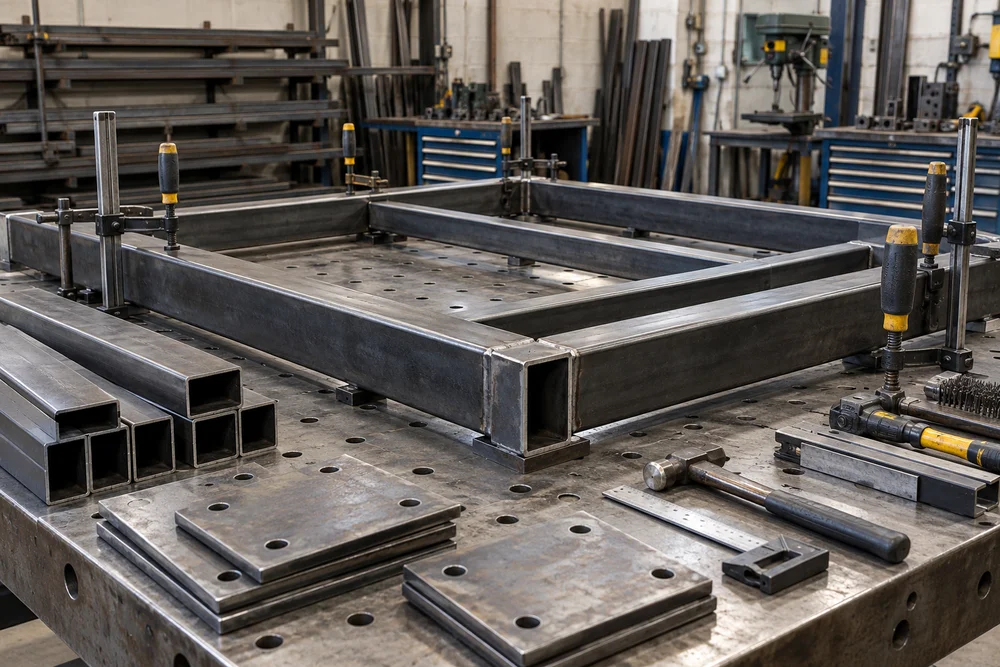
Steelwork That Fits The Job
Steel fabrication turns stock sections, plate and tube into components made for a particular purpose. Enquiries can include support frames, equipment bases, brackets, connection plates and secondary building steelwork. Start by explaining what the item needs to do and which other components it will connect to.
A frame supporting equipment needs different checks from a decorative screen or protective cover. Tell us whether the item carries a load, attaches to a building or interfaces with machinery. That information helps establish who needs to provide the design and what technical records should accompany the order.
We welcome enquiries for one-off components and repeat assemblies. Include your drawing revision, quantities and delivery postcode, together with the dimensions that control fit. If you only have a sketch, identify which details are confirmed and which still need development.
From Drawing To Fabricated Component
A fabrication drawing should show section sizes, hole positions, weld details and the specified finish. Label the fixed reference points and mark any mating surfaces. Photographs are useful context, but they cannot replace measured dimensions when a part must fit an existing assembly.
Cutting establishes the lengths and profiles, drilling prepares connections and fit-up positions the parts before joining. Welding can affect alignment, so the manufacturing sequence needs to account for distortion. Inspection should compare the completed assembly with the approved drawing rather than an earlier pricing sketch.
Agree whether welds remain visible, edges need dressing and exposed faces require a particular finish. Grinding every weld flush adds work and can be unsuitable for a structural connection. Appearance requirements are most useful when they describe a visible surface or reference an agreed sample.
Standards And Design Responsibilities
For structural components within scope, BS EN 1090-1 concerns conformity assessment and BS EN 1090-2 sets execution requirements. The designer should identify the relevant requirements and execution class. Check the proposed manufacturer’s supporting documentation against the specific components being supplied.
Engineering calculations and connection design need a named responsibility within the project. A workshop drawing does not automatically provide structural verification. See the structural steel guide for information on beams, bearings and load-bearing frames.
Workshop equipment is subject to the Provision and Use of Work Equipment Regulations 1998, commonly called PUWER. Welding fume needs suitable assessment and controls under COSHH. These duties concern how work is carried out and do not replace checks on the finished product.
A Practical Fabrication Process
First, define the brief. Share the current drawings, quantity, purpose and delivery location. Highlight unresolved design questions, any necessary engineering input and the features that must match another component.
Next, settle the detail. Agree material grade, weld requirements, tolerances and finish, with a clear point for approval. Record exclusions such as site measurement, fixings, engineering, lifting and installation so the same work is not assumed to sit with different parties.
Manufacture then follows the approved information. The inspection plan should identify important dimensions and any required records before production begins. A trial assembly can be useful where several parts must fit together or where connection access is restricted.
Finally, plan handover. Confirm identification, protective packing and unloading arrangements. A long welded frame may need a different vehicle or lifting plan from a collection of loose plates, so delivery should be considered while the design is still being developed.
What Affects Fabrication Cost
Material quantity is only part of a fabrication price. Cutting complexity, the number of holes, fit-up time, weld access and inspection can change the effort involved. A small assembly with many connections can require more workshop time than a much larger simple frame.
Repeat quantities can share drawing preparation, jigs and machine setup. Surface preparation, coating and delivery add their own requirements. Ask for a written scope that distinguishes fabrication from finishing, transport and installation before comparing quotations.
Describe access restrictions and whether an assembly can arrive in one piece. Splitting it for transport affects connections, appearance and fitting time. For thin folded panels, read our sheet metal fabrication guide.
A change after approval can mean revised drawings, material already cut or work that must be repeated. Agree the point at which manufacturing information is frozen and how later changes are authorised. If a proposed substitution affects performance, refer it back to the responsible designer.
Questions, Answered
Can You Work From A Sketch?
A sketch can start a steelwork enquiry when it shows the intended layout and key dimensions. Photographs of the installation location are helpful too. Safety-critical work still needs an appropriate design and approved fabrication details. Make clear which measurements have been checked and which are estimates so assumptions can be recorded.
Is Installation Included In A Fabrication Quote?
Installation is included in a fabrication quote only when the written scope says so. Supply-only, delivery and installation are separate arrangements that should be clear before ordering. Discuss lifting, temporary support, access equipment and site responsibilities. The project team should coordinate construction activities and confirm who controls the work area.